



The 1982 Commonwealth Games
In 1982 the Commonwealth Games landed in Australia. This ran from 30 September to 9 October in and around the city of Brisbane. Forty-six nations competed and a new record was set, with a total of 1,583 athletes and 571 officials taking part. Australia finished at the top of the medal table, ahead of England, Canada, Scotland and New Zealand.
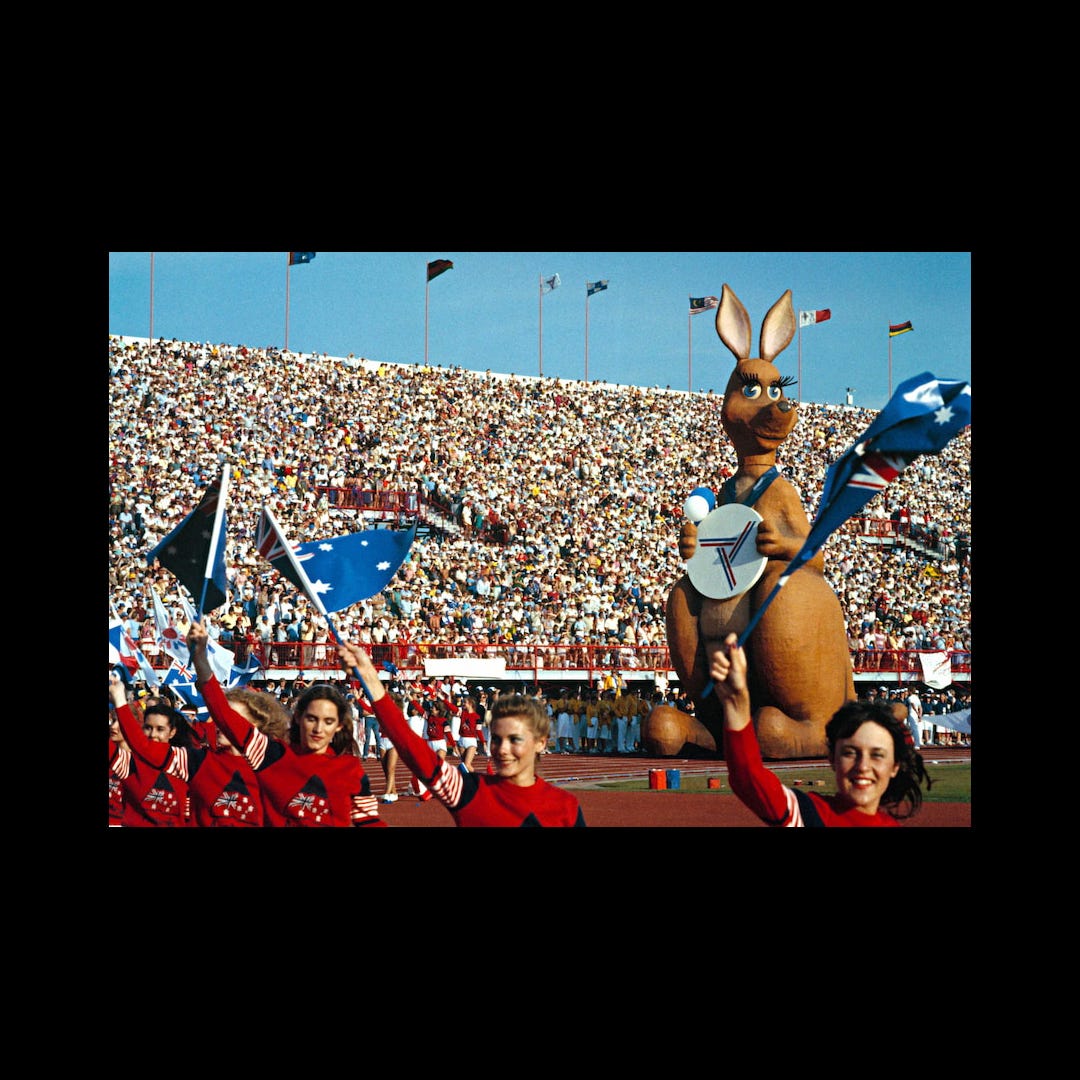
At the opening ceremony–which took place in the QE II Jubilee Sports Centre, in the Brisbane suburb of Nathan–it was Matilda, a giant mechanical kangaroo, that stole the show. Matilda, the mascot of the Games, was designed by Hugh Edwards and was built as an impressive representation of the emblem of Australia. The logo however, which was also designed by Edwards, took a more abstract approach.

A nationwide competition
While the games took place in 1982, the logo was designed four years prior in 1978. This was the outcome of a nationwide competition. The winning logo was submitted by Hugh Edwards, a little known designer at the time. His design playfully drew its inspiration from a ‘bounding’ or ‘flying’ kangaroo, the official and internationally recognised emblem of Australia.
Key Takeaways
A competition-winning design
Hugh Edwards, then a little-known designer, won a nationwide competition in 1978 to design the logo for the 1982 Commonwealth Games in Brisbane.
A stylised A for Australia
Three red and blue bands abstract the bounding kangaroo into an ‘A’, with colours drawn from the flags of Commonwealth nations and the Union Jack.
Overshadowed by Matilda
Edwards also designed the pictograms, medals and mascot, but it is Matilda, the giant winking kangaroo, that is best remembered.
Explore more like this in Sportswear Logos →
Go behind the logos. Explore 200+ in-depth and meticulously researched logo histories revealing the designers, design decisions and ideas behind the world’s most iconic logos and important brand identities.
Continue reading to discover how Edwards abstracted the kangaroo into a stylised A, and the pictograms, medals and mascot that followed →
