


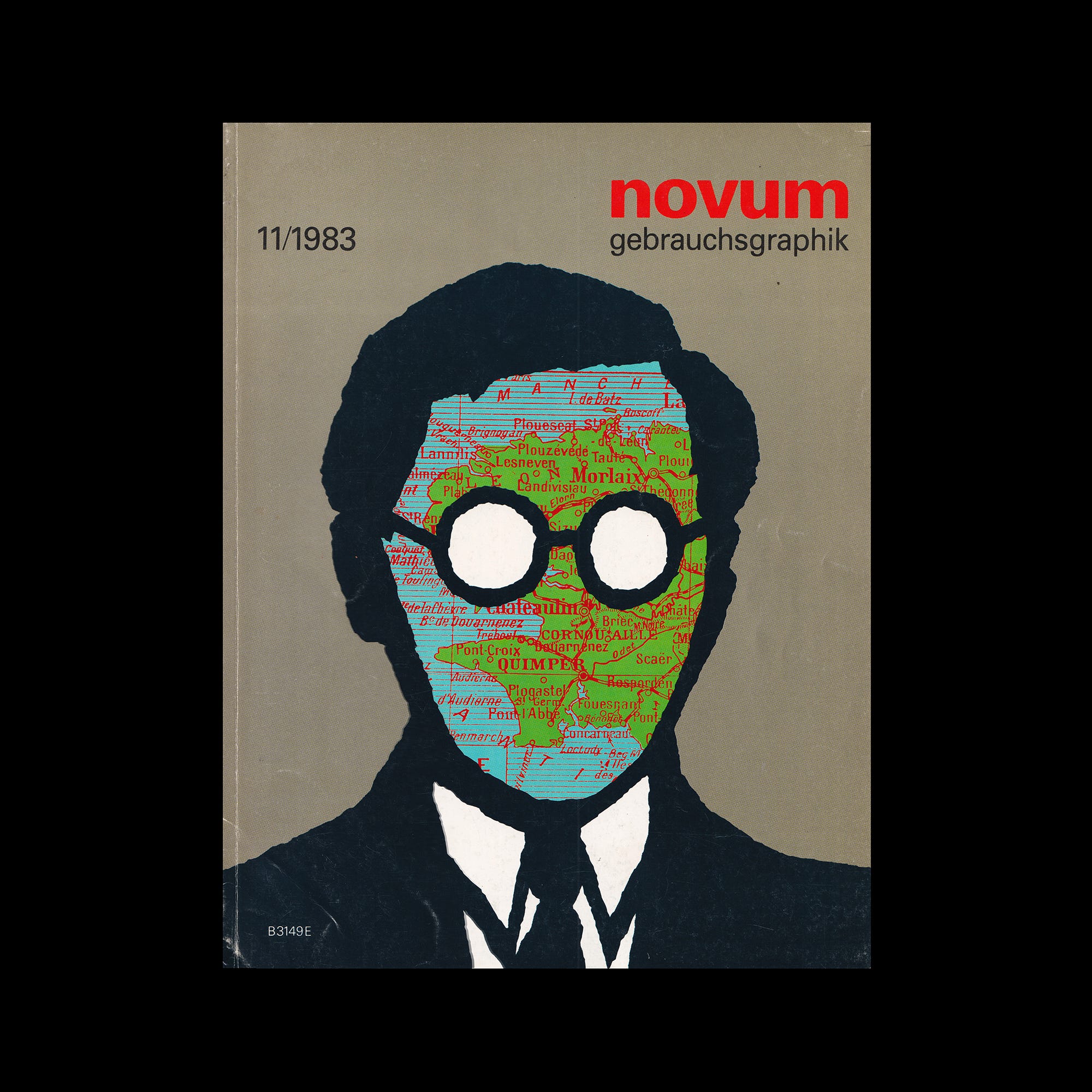
The following is an article published in Novum Gebrauchsgraphik, November 1983. In it, Peter Bartl writes about Canadian graphic design.

Discover more design magazines here.
The Society of Graphic Designers of Canada recently celebrated its 25th anniversary. The occasion was marked by a nation-wide competition of the best graphic design produced in Canada in the last five years. Selected by an international jury, the best 200 of a total of 1600 entries were presented in a travelling exhibition.
Canada is a young nation, peopled by immigrants from every part of the world who have to a great extent retained their national identities. We often speak of Canada as a cultural mosaic, whereas Americans consider the United States a melting pot. Graphic designers are no exception to this social pattern. The absence of a design education tradition of national significance still forces young designers to seek further professional education in Europe and the United States. Only in the last ten years have some institutions developed programs of more than local significance. The most active design education programs in the country are presently offered by the Nova Scotia College of Art and Design (Halifax), Université de Quebéc (Montréal), York University (Toronto), and University of Alberta (Edmonton).
Explore more like this in Logo Design History by Country →
Go behind the logos. Explore 200+ in-depth and meticulously researched logo histories revealing the designers, design decisions and ideas behind the world’s most iconic logos and important brand identities.
Among the few Canadian-born designers of international stature, the name of Carl Dairs (1912-1967) stands out as the most influential designer and teacher in Toronto recently arrived in the region or by former students of the University of Alberta.
Many of the trends and tendencies outlined above can ultimately be traced back to the one Canadian reality - the vastness of the country. Despite instant communication through radio, television and telephone, Canada is still a country of distinct regions. Individuals and designers identify first with their geographic region. The influences that designers are exposed to therefore also have a strong regional flavour. Designers in the Maritime Provinces tend to follow trends that are current on the Eastern seaboard of the United States, Toronto looks frequently to New York, the Prairie Provinces borrow from Europe or the American Midwest, and British Columbia has a strong West Coast outlook.
This lack of Canadian identity is also reflected in the attitude of many large corporate clients. Over the years a number of prominent visual identities have been developed by studios in the United States. Despite the excellent international reputation of many Canadian designers, clients often lack confidence in their ability to handle large, long-range projects. The American design of the visual identity for Petro-Canada, the national petroleum exploration and marketing agency is just the latest example of what could be called a Canadian tradition. Despite these handicaps, Canadian designers from coast to coast will continue to produce excellent work, and many enthusiastic young designers have the skills to meet the challenges of the evolving Canadian design scene in new and fresh ways.
Want more in-depth articles? Check out LogoHistories’ other articles on Canadian logos →


Thank you for subscribing to Logo Histories. If you enjoy reading this short you may also enjoy these resources from the same team:
Brand Archive – Research tool for brand designers.
LogoArchive Website – Searchable modernist logo archive & research tool.
LogoArchive Shop – Vintage design books & LogoArchive Zines.
BP&O – Contemporary design editorial.