


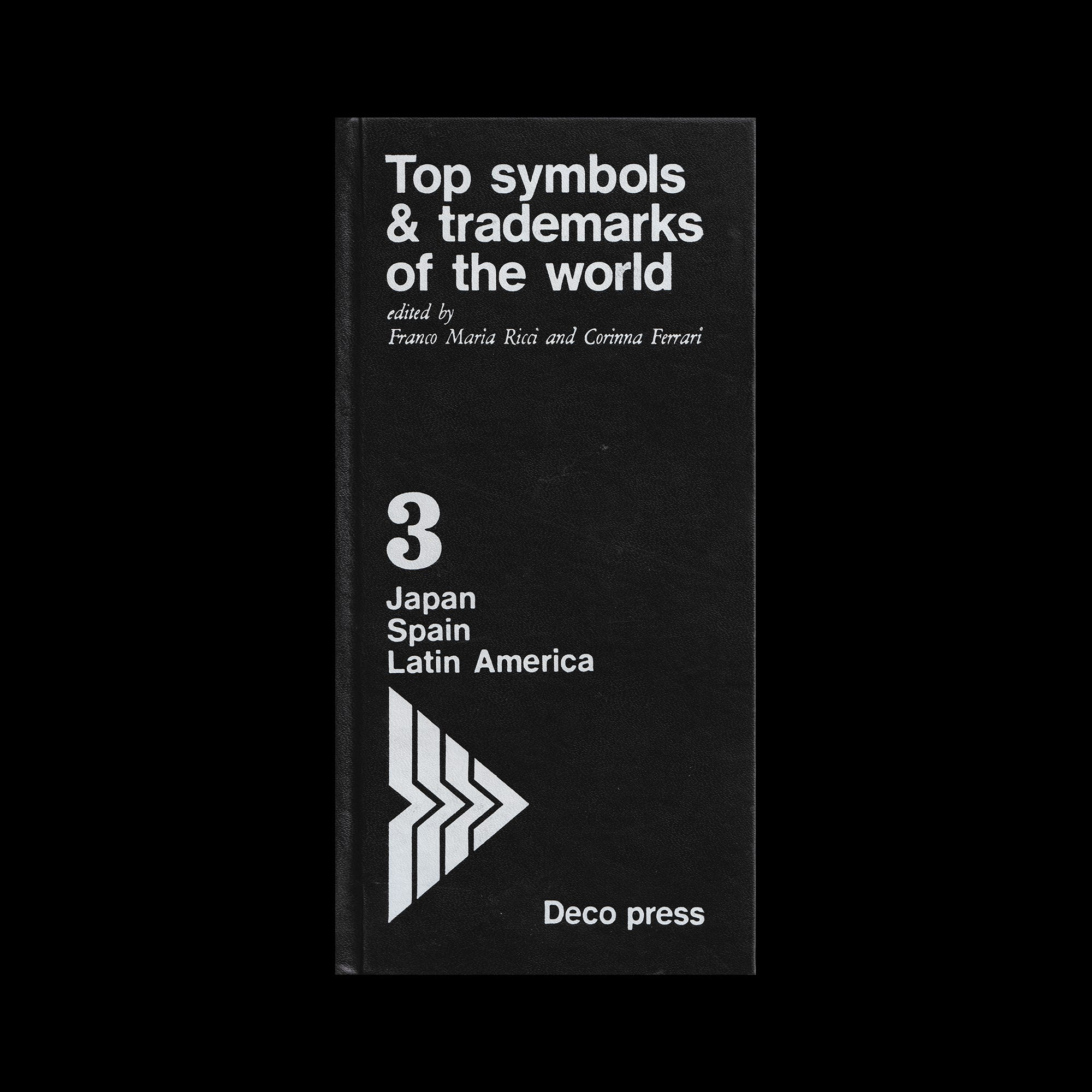
The following is an introduction published in Top Symbols & Trademarks of the World Volume 3, 1973. It introduces the logos and trademarks of Latin America.

Today, trademarks or symbols constitute a linguistic code within Semiotics - the science of signs. They are part of the phenomenon of multiplication of codes which derived from the Industrial Revolution - a revolution in which we are still immersed - and which is already entering its second phase, that of automation or electronics.
The trademark is by nature ideographic; it first saturates and then transcends the verbal code, entering into the realm of non-verbal writing. Its structure and construction are isomorphic in the manner of the oriental ideogram. And progress in reproduction techniques makes them even more similar to one another, since it is now possible to create marks that are informal, or non-geometric (in Euclidean terms).
Explore more like this in Logo Design History by Country →
Go behind the logos. Explore 200+ in-depth and meticulously researched logo histories revealing the designers, design decisions and ideas behind the world’s most iconic logos and important brand identities.
The evolution of trademarks is a function of industrial development, in its phases and states. Today, in countries like Brazil, Mexico, Argentina, and Venezuela, we are witnessing a real proliferation of marks. The industrial firms - large, medium and small - the banks, studios and art galleries, professional services, (architecture, engineering, data processing, etc.), even single professionals, all want their own symbols.
The fact is that the trademark forms a part of a much vaster whole, called Visual Image or Identity - and this part of an even larger whole, which can be called Industrial Design or simply Design. The Latin American countries do not yet have the linguistic repertory which would permit the necessary "know-how" in respect to Industrial Design, which is only now taking its first steps. It is calculated that, in Brazil alone, about twelve million dollars are paid each year to foreign designers. This is not the case with Visual Programming or Communications (Visual Image), where the "know-how" is sufficiently advanced - the trademark being the initial point of the "absorption/ creation" of a linguistic repertory.

Until now it has been a few professionals who were responsible for the majority of the trademarks: they are the pioneers who succeeded in asserting themselves as designers. One may also observe that the farther back the works are in the past, the more they represent a type of geometric rigorism, à la Bauhaus-Ulm. And it is not difficult to imagine how greatly the number of designers active in Visual Programming has increased in the last five years, as a result of the expanding market. Today, all the best professionals of Brazil, Mexico, Argentina, Venezuela and Peru are aware that the problem is not only one of designing trademarks, isolated from the wider scope: they reject designing simple marks in their effort to pave the way to the broader, more extensive work of Visual Image; which includes the trademark and general visual codification of firms (administrative documents, officials' uniforms, industrial signs, coded standardization of groups of vehicles, packaging, etc.). In this effort they are trying to follow the examples of Olivetti, of Volkswagen, of IBM. A dilettantism prevails in the less developed countries, which also affects the workings of government agencies in the more advanced countries - bureaucracy, conflicts of interest and prestige between the various government departments, etc. But it is private firms that have been most susceptible to visual rationalization.
Thus, much as the "word" (written or spoken) has been a kind of substitution technique for an almost non-existent "know-how", in the same manner Visual Programming constitutes a technique of substitution for technology in it "absorption/ creation" phase, in the context of Industrial Design.
Want more in-depth articles? Check out LogoHistories’ other articles on Latin American and international logos →


Thank you for subscribing to Logo Histories. If you enjoy reading this short you may also enjoy these resources from the same team:
Brand Archive – Research tool for brand designers.
LogoArchive Website – Searchable modernist logo archive & research tool.
LogoArchive Shop – Vintage design books & LogoArchive Zines.
BP&O – Contemporary design editorial.